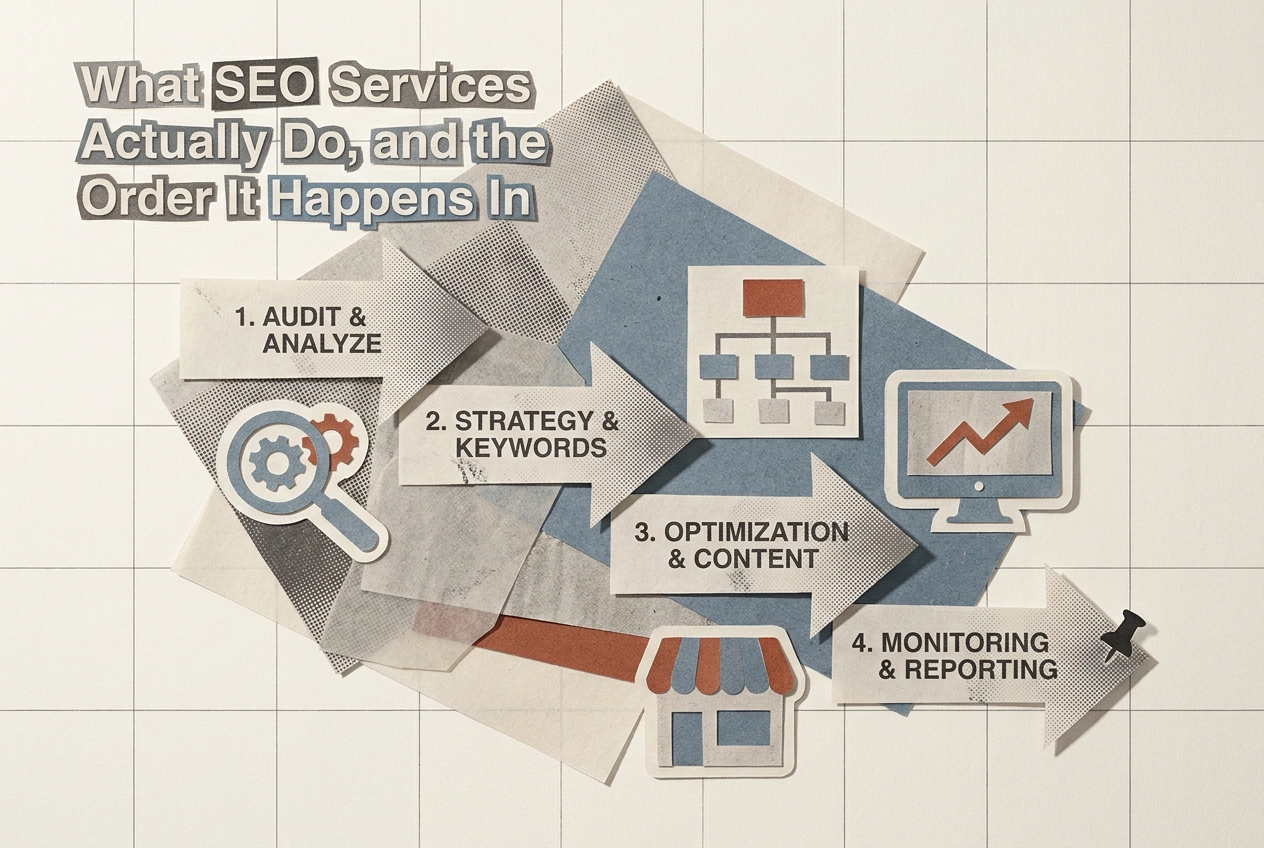
If you have ever paid for SEO and wondered whether anything happened beyond a monthly invoice, you are not alone. For a beginner, SEO can feel like a black box: reports arrive, rankings move slowly, and nobody explains the sequence. This post opens the box. It explains what SEO services for small businesses do, in the order the work should happen, so you can judge progress with your own eyes. Treat that order as your audit checklist.
You will learn why the order of work is the real quality test. We will walk through Stage 1: technical and indexing health, and what you should be able to see afterward, such as indexing reports or sitemap checks. Then Stage 2: page and content improvements once search engines can reach them, and the visible changes that should follow. Next, Stage 3: local SEO services and authority work, with its own proof points. Finally, we will cover how to use this order when paying for SEO, what changes and stays the same with SEO services in the UK, and three questions that make SEO easy to audit. If a provider cannot explain the work in this sequence, the invoice is harder to justify.
Why the order of the work is the real test of SEO services for small businesses
SEO services are usually sold as an outcome: more enquiries, better rankings. You cannot audit an outcome in advance, but you can audit a process. Ask any provider what happens first, what happens second, and what you will be shown when each stage ends. Judge the answers by how concrete they are.
A defensible order runs technical and indexing health first, page and content improvements second, local and authority work third. Treat that as a claim with reasons attached, not a rule handed down. A page search engines cannot fetch cannot rank, so content work before reachability risks spending budget on pages nobody sees.
Google keeps crawling and indexing grouped as its own topic area, and publishes a page on whether you need an SEO, signalling that reachability and hiring are both in view.
Small-business SEO is not one job. Read the process as a sequence of jobs, far easier for a non-specialist to check than a dashboard number you cannot interpret.
A provider who cannot explain the stages in plain English, and say what each one is for, is a commercial problem before a technical one. That is a legitimate reason to walk away.
Here is what happens in each stage, why it sits where it does, and what you should see.
Stage 1: technical and indexing health comes first
First question: can search engines reach, read and store your pages at all? A page a crawler cannot fetch cannot rank, however good its copy.
In plain terms: crawling is when a search engine fetches a page; indexing is when it stores that page and can show it in results. Ask your provider to use both precisely.
The checks themselves are unglamorous: can search engines find your pages through links and a sitemap, is anything blocked in robots.txt by accident, do your URLs work the same with and without the www, and does each page have one clear canonical address? The stage also covers redirects from old addresses, broken links, duplicate versions of the same page, and whether key pages render in a form search engines can read rather than only in a browser.
This comes first because page, content and local work sits on top of reachable pages. Improvements made too early can be spent on pages search engines never see, which is how budgets quietly disappear. It is also where an older website, a recent redesign or a hosting move usually surfaces as the underlying cause, one reason website design, development, hosting and SEO are often best handled together. Include search visibility in the brief when commissioning a website.
What you should be able to see after Stage 1
Once Stage 1 work is under way, ask for evidence you can inspect. Request the indexing report in Google Search Console, showing which pages Google has stored and which it has not, including any reasons for exclusions.
Ask for sitemap submission status, then a plain description of what changed in robots.txt, canonical tags or redirects, with the affected URLs listed.
Ask for a redirect log: every old address now pointing to a new one, so you can confirm nothing you ranked for was dropped during a redesign or hosting move.
Ask what done looks like here. Reachability is a state, not a score. The honest answer is a short list of resolved issues plus anything outstanding, not a percentage. Check the visitor journey as well as the dashboard when reviewing how those pages behave for visitors.
Red flag: a report showing a tool’s own score rising without naming a single URL, tag or file that changed on your site.
Stage 2: pages and content, once search engines can reach them
Once indexing is healthy, the question becomes whether each page answers something people actually search for, better than the pages already ranking.
Typical work: one clear topic per page, titles and headings written for people first, service and location pages that state plainly what you do and where, and internal links that move a visitor to the next useful step. It is not keyword stuffing, a page for every town in the county, or marketing language that strips out the detail a buyer needs. Google’s spam policies treat pages built for search engines rather than users as doorway pages.
Order matters within this stage. Improve pages already attracting attention before commissioning new ones, since refining an existing page is a smaller job than starting from nothing and waiting.
The highest-value small-business content is unglamorous: service pages, pricing, coverage areas, lead times, and straight answers to the questions your phone already receives. A rebuild is a natural moment to get these right, which is why planning a new business website and SEO are best handled together, with the process documented page by page.
What you should be able to see after Stage 2
Ask to see the specific pages that changed, with before and after text for at least two of them. That lets you judge whether the writing still sounds like your business and still says what you sell.
Ask which searches each page is meant to answer, and how the provider knows people use those words. Search terms reported in Search Console are evidence; plausible-sounding guesses are not.
Ask what happened to any pages that were merged, redirected or retired, and where visitors and links pointing at them were sent instead.
Ask for a short written summary a non-specialist can read: what changed, why it changed, and what the next round of page work will cover. If that summary cannot be written, the reasoning may not exist.
Red flag: content published in bulk with no page-by-page reasoning, or new pages repeating one template with only the town name changed. Pages scaled mainly to manipulate rankings are treated as spam, and published analysis of scaled content abuse notes volume alone is not the trigger.
With that evidence in hand, local and authority work has something solid to build on.
Stage 3: local SEO services and authority work
Local and authority work is about being findable where you trade and trusted enough to be chosen. In practice that means business listings, consistent name, address and phone details, pages for the areas you serve, reviews, and mentions or links from other sites.
Local work sits third for a reason: a listing points at a page, and that page must already be reachable and useful.
Local SEO services for a small business usually cover your Google Business Profile, correct details across the directories that matter in your trade, and location pages that describe real coverage rather than invented towns.
Authority work is slower and harder to fake. Trade associations, local press, supplier and partner listings, and genuine review activity all take time. Ask what will actually be done rather than what is hoped for. In the UK, buying or concealing incentivised reviews is not merely a ranking risk: the Digital Markets, Competition and Consumers Act 2024 treats fake reviews as automatically unfair and illegal, and businesses publishing reviews are expected to take reasonable steps to remove them.
If your business is online-only or sells nationally, this stage looks different, but the principle holds. Build the signals that match how your customers actually find and shortlist businesses like yours.
Be cautious with anyone who treats this stage as a shortcut. Some easy wins here are also the fastest way to damage trust with customers and with search engines. Next, we look at what you can ask to see once this work is claimed as complete.
What you should be able to see after Stage 3
Stage 3 produces evidence you can inspect directly, so ask for it.
First, the listing itself. Open your business profile and check the categories chosen, the description, opening hours, and the services or photos attached. Correct anything wrong before the next round of work.
Second, the directory list. Ask which sites you were added to, then verify the details match your website and that no old address or disconnected phone number is still live anywhere.
Third, the review plan. Ask how customers are asked, who replies, and how quickly. Reviews should be requested openly from real customers — the risks of shortcuts are explained in Stage 3 above.
Fourth, a plain list of outreach or mention activity, naming the sites contacted and the outcome. A vague line about building links tells you nothing. You are entitled to know where your business name appears.
One red flag should stop you: promises of a set number of links, or a guaranteed position in results. Neither is within any provider’s control. Treat both as a sign to ask harder questions.
That gives you four checks to set against the invoice.

How to use this order when you are paying for SEO
Apply that same test to the contract. Ask each provider to describe the opening stages and name the artefact you will see at the end of each: an indexing report, a redirect log, a changed page, an updated listing. If nothing checkable is named, ask again.
Put the sequence in the agreement, not just the monthly fee. State what is in scope, what you will receive, and how often you speak to the person doing the work rather than an account manager.
Keep your own access. Search Console and analytics should sit on accounts you own or can log into as an administrator, so you are never locked out of evidence about your own website. Book a short monthly review and look at one report together. It is dull, and the best defence against paying for activity nobody can show you.
Check who handles the overlap between your website, your hosting and your SEO. If different suppliers hold them, ask who fixes a broken redirect or a slow page, and expect a named person rather than a shrug. Studios such as Neil Foulkes / Digital Strategist work as an extension of client teams and offer website design and development, SEO, hosting and ongoing support, keeping that layer with one supplier.
SEO services in the UK: what changes and what stays the same
The order stays the same wherever you are; the details change. UK customers often search with a town, region or “near me” phrasing, and how you are found locally depends on how consistently your business is described in the places that matter for your trade.
That usually means matching your name, phone number, address and opening hours across your website, your business profile and the main directories and trade listings for your sector, formatted identically everywhere. Ask a local SEO provider which listings genuinely matter for your trade, rather than accepting the same town-page template applied to every client.
If you collect enquiries or customer details, your site should say what you collect and why, and your forms and analytics should gather only what you need. UK data protection rules apply, and you should check where responsibility sits with the relevant authority.
Small UK details shape how you are presented and found: currency and units, how opening hours are written, whether you show a registered address or a service area, and whether you deliver UK-wide or serve one town.
Conclusion: the three questions that make SEO easy to audit
Judge an SEO service by the order it works in and what it shows you at each stage.
Before you sign, ask three questions:
- What happens first?
- What will I see when that stage is finished?
- Who do I contact when something breaks?
If a provider cannot explain the work in these terms, the fee is hard to justify. That is the whole test, and it costs nothing to apply.